Call020 4520 0658 Emailinfo@sidcupminibushire.co.uk Quote within the hour

Minibus & coach hire with a driver · Sidcup DA14 & DA15

Minibus hire in Sidcup, where the bridge at your own station stops a double-decker

Sixteen seats that fit down a 1930s side street, and up to seventy when the group is bigger than the street. Foots Cray Meadows, Queen Mary’s, Rose Bruford, the A20 out to Kent — quoted within the hour.

  • We start from the vehicle, not the postcode. Sidcup is mostly interwar semis on streets built for one car per house. A 16-seater turns where a 12-metre coach has to reverse, and we will say so before you book, not after.
  • LEZ and ULEZ compliant. Sidcup is in the London Borough of Bexley, inside Greater London, so both zones apply here. Nothing is passed on to you.
  • DBS-checked drivers for school and youth groups, seatbelts throughout, risk assessments on request.
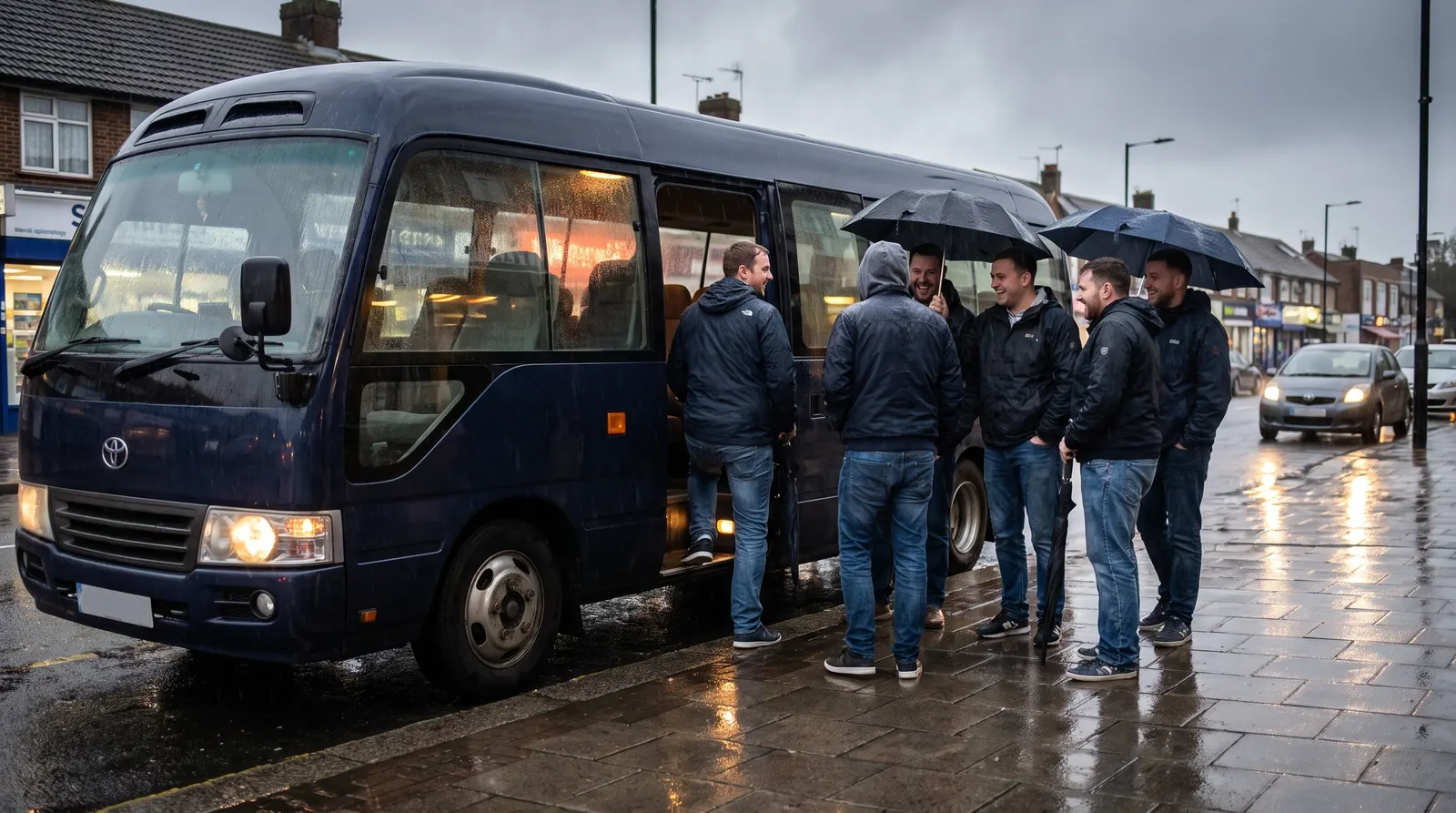
A dark navy 16-seat minibus at the kerb on Sidcup High Street in heavy rain, its door open and interior lights on, a group of men in their twenties and thirties in coats and under umbrellas waiting to board beside wet paving and shopfronts
Sidcup High Street, in the rain, which is when a minibus earns its money. Sixteen people, one kerb, thirty seconds of loading. The same group in a full coach would be blocking the parade while the driver looked for somewhere legal to stand.
What people hire us for

Six jobs a Sidcup minibus actually gets booked to do

01

Hospital visits and staff runs

Queen Mary’s on Frognal Avenue is about twenty-five minutes’ walk from Sidcup station, which is a long way when it is somebody’s mother. A minibus does the door.

02

School and college trips

DBS-checked drivers, seatbelts throughout. Foots Cray Meadows is a field-study morning two kilometres east; the rest of Kent is out through the A20.

03

Theatre nights and showcases

Rose Bruford College sits in Lamorbey Park with its own theatres, and Burnt Oak Lane is a residential road. A 16-seater is the right size for an audience party.

04

Airport transfers

London City is the near one, Gatwick via the M25, Heathrow the long way west. Luggage in the boot rather than on knees.

05

Nights out, one late pick-up

The Dartford Loop into Cannon Street and Charing Cross is fine at seven and no use at one. A booked minibus does not care what time the last train left.

06

Weddings and funerals

Guest shuttles between church, reception and hotel so nobody drives. Handled quietly and on time when it matters most.

The distinction this domain is named after

Minibus or coach, and why in Sidcup it is usually the minibus

Most towns can take either. Sidcup is a place where the choice does real work, for three reasons that have nothing to do with price.

  • The streets are interwar, and so are the turning circles. Much of DA14 and DA15 is 1930s semi-detached ribbon development with cars parked both sides. A 16-seat minibus is about the size of a large van. A 12-metre coach is not, and there is often nowhere to turn it round at the far end.
  • Height. A 16-seater is roughly 2.8 m tall. A 53-seat coach is up to 3.87 m, and a 70-seat double-decker 4.4 m — which, as the table below shows, is exactly the signed limit under the railway at Sidcup station.
  • Where the group actually is. Hospital entrances, a college drive, a park gate on a lane. These are minibus places. A coach makes sense when you are all leaving Sidcup together for somewhere with a coach park at the other end.

We run both. The honest version is that if there are sixteen of you and the destination is inside the M25, the minibus is nearly always the better vehicle, and it is not the more expensive one.

Things to do

What is actually in Sidcup

Sidcup is in the London Borough of Bexley, so plenty of the borough’s best-known places — Hall Place, Danson House, Red House — are near neighbours rather than local. We say which is which.

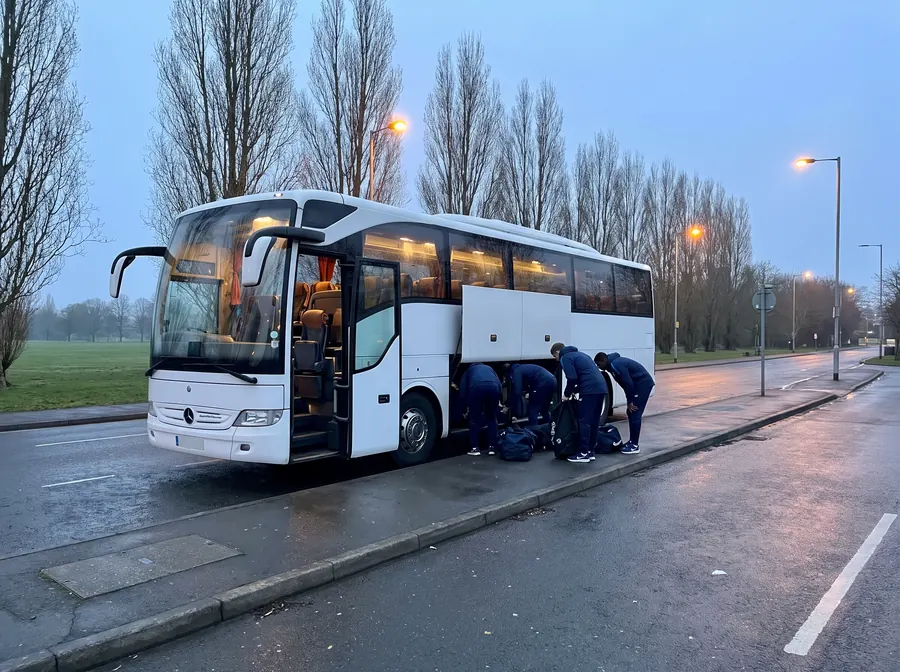
A white touring coach at the roadside beside open meadow and bare poplar trees at dawn, street lamps still lit, a sports team in navy tracksuits loading kit bags into the luggage bay
Foots Cray Meadows Around 100 hectares of parkland and woodland along the River Cray, the largest open space in the borough, owned and managed by Bexley Council. The Five Arch Bridge in the middle of it is Grade II listed and dates from Lancelot ‘Capability’ Brown’s landscaping of North Cray Place around 1780–81.
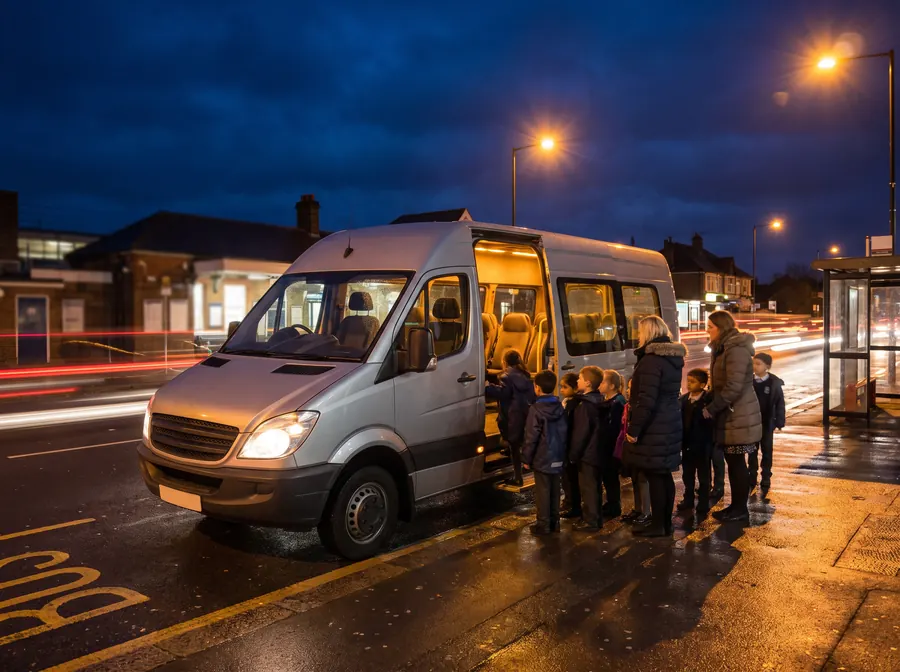
A silver 16-seat minibus at the kerb outside Sidcup station at night, door open and interior lit, a school group in uniform waiting in a line with two teachers, wet road reflecting orange street lights
Sidcup station and Station Road The Dartford Loop platform that put Sidcup on the map, and the road under it. Trains reach Charing Cross, Cannon Street and London Bridge; the road beneath the railway is signed at 4.4 m, which is the one number on this page a booker most needs.
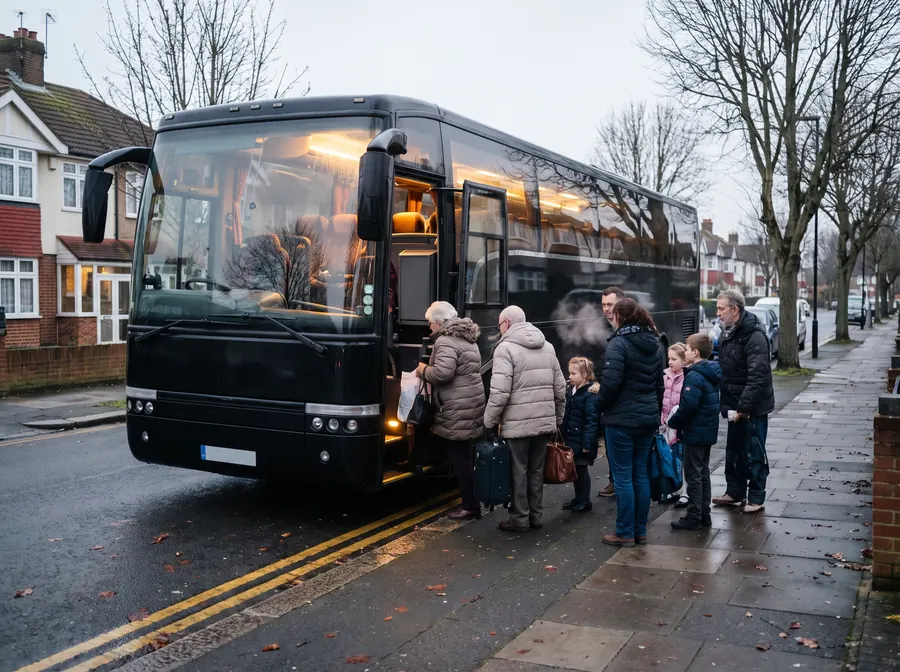
A black executive touring coach parked on double yellow lines on a Sidcup street of 1930s semi-detached houses on an overcast winter afternoon, an extended family of grandparents, parents and children boarding with suitcases
The residential streets This is most of Sidcup, and this photograph shows the compromise honestly: a full coach on a 1930s street is on double yellows, loading, for as long as it takes and no longer. For a family group it is a five-minute job. For a school pick-up it is why we suggest a minibus.

Sidcup Place

A house of about 1743 whose grounds were opened as a public park in 1934, when it became the offices of the newly combined Sidcup and Chislehurst Urban District Council. Still owned by the London Borough of Bexley. Terraced gardens, a ha-ha and a walled garden survive.

DA14 6BN · about 0.4 km south of the High Street

Rose Bruford College, Lamorbey Park

A drama conservatoire founded in 1950, on a campus built around Lamorbey House. It has its own theatres and a public performance season, which is the reason a Sidcup minibus gets booked for an evening rather than a day.

Burnt Oak Lane, DA15 9DF · 1.4 km north of the town centre

Chislehurst Caves — near, but not in Sidcup

Under four kilometres south-west, at BR7 5QX in the London Borough of Bromley rather than Bexley. Worth naming here only for the route: the sensible way there from Sidcup avoids the low railway arches around Chislehurst and Elmstead, which are dealt with in the table below.

BR7 5QX · Bromley, not Bexley

Queen Mary’s Hospital

Frognal Avenue, DA14 6LT. A community hospital run by Oxleas NHS Foundation Trust with services delivered in partnership with several other trusts — and, as the long read below explains, the place where modern plastic surgery was invented.

DA14 6LT · about 25 minutes’ walk from Sidcup station

Sidcup High Street · DA14 6 Lamorbey Park · DA15 Albany Park station · for the Meadows Ruxley · east of the town Hall Place · same borough, 4.7 km
The practical bit

Where a minibus can actually pick up in Sidcup

Sidcup has no coach park that anybody publishes. What it has is a high street with bus stops and loading restrictions, a station road with a railway bridge over it, a hospital with its own car park, and a great many residential streets. That is a perfectly workable set of options if somebody has thought about it.

What we use

  • Station Road, at Sidcup station — the default for anything meeting a train. Note the 4.4 m limit under the railway itself: fine for a minibus or a full-height coach, not for a 70-seat double-decker.
  • Frognal Avenue, at Queen Mary’s Hospital — the hospital publishes 350 pay-and-display public spaces with disabled bays outside each main building. A minibus sets down at the door; a coach waits off site.
  • Rectory Lane, for Foots Cray Meadows — the meadows’ car park is reached from Rectory Lane. It is a car park, not a coach park, so for anything larger than a minibus we set down on the road and collect at the same point at an agreed time.
  • Burnt Oak Lane, for Rose Bruford College — a residential road serving the campus. Sixteen seats is comfortable here; fifty is a conversation to have with the college first.
  • Your own street — for a family, a wedding party or an airport run, we will come to the door. Tell us if it is a cul-de-sac and we will send something that can get out again.

And the thing about the Sidcup Bypass

The A20 runs past the town as the Sidcup Bypass — a 5.82 kilometre length of the London–Dover trunk road through Bexley and Bromley, between County Gate and the Swanley Bypass. It is how a coach gets in and out of Sidcup without touching a residential street, and it is quick.

It is also a road you cannot change your mind on. A 1987 Order prohibits right turns off several accesses onto the Bypass, closes gaps in the central reservation, restricts the slip roads at Frognal Corner and Crittalls Corner, and reserves the emergency crossing points for emergency vehicles. In practice that means a missed pick-up on the Bypass is not a U-turn, it is a loop. We build the extra few minutes into the plan rather than into the apology.

The A20 Trunk Road (Sidcup Bypass, Bexley and Bromley) (Prescribed Routes) Order 1987, made 26 August 1987 — legislation.gov.uk, read 29 August 2026.

Tell us the address rather than the town and we will name the pick-up point in the quote, including the bit where we say a road will not take the vehicle you asked for.

The bit nobody publishes

Twelve height limits near Sidcup, and only one of them is in Sidcup

We checked every one of these against its map position before writing it down, and the result was a surprise: eleven of the twelve are in Bromley or elsewhere in Bexley. The twelfth is the railway bridge on Station Road at Sidcup station, and it is the one that matters. A full-size coach is 3.68 m as a Mercedes-Benz Tourismo with roof air conditioning and 3.87 m as a 53-seat MAN Lion’s Coach, so we plan every job to 3.9 m. A 70-seat double-decker is 4.4 m, and a 16-seat minibus about 2.8 m.

Signed height limits on roads near Sidcup, where each one is, and which of a 2.8 m minibus, a 3.9 m coach and a 4.4 m double-decker it stops
RoadLimitImperialWhat it stops
Station Road Sidcup station, DA15 — under the Dartford Loop4.40 m14′5″The decker only
Manor Way Bexley DA5, 3.4 km NE — also under the Dartford Loop2.80 m9′2″Everything
Page Heath Villas Widmore, Bromley BR1 — 5.4 km SW3.80 m12′5″Coach and decker
Chislehurst Road Bickley, Bromley BR7 — 3.8 km SW3.81 m12′6″Coach and decker
Barfield Road Bickley, Bromley BR1 — 4.1 km SW3.96 m12′11″The decker (and we would not risk a 53-seater)
New Street Hill Sundridge, Bromley BR1 — 5.4 km W3.96 m12′11″The decker (and we would not risk a 53-seater)
Homesdale Road Widmore, Bromley BR1 — 5.4 km SW4.11 m13′5″The decker only
Sheepcote Lane St Mary Cray, Bromley BR5 — 4.6 km SE, a tunnel4.20 m13′9″The decker only
Elmstead Lane Elmstead, Bromley BR7 — 4.0 km W4.27 m14′0″The decker only
Summer Hill Bickley, Bromley BR7 — 3.8 km SW4.40 m14′5″The decker only
Central Avenue Welling, Bexley DA16 — 4.2 km N4.40 m14′5″The decker only
Bexley High Street Old Bexley DA5 — 3.8 km NE4.50 m14′9″Nothing we run

Level with the sign is not clearance

Four of these are signed at exactly 4.40 m, and a 70-seat double-decker is exactly 4.4 m tall. That is not a margin, it is a coincidence, and one of the four is the bridge on Station Road at Sidcup station. If a group of seventy asks us to meet them off a train at Sidcup, the answer is two coaches or a different pick-up point — not a decker and some optimism.

The genuinely hard one is Manor Way at 2.80 m, under the same railway three and a half kilometres north-east in Bexley. Nine foot two stops our smallest vehicle as surely as our largest. It is the only closed door on this list, and it is not in Sidcup.

What a list like this cannot tell you

These are the signed limits recorded on the map. They are not the whole story of a route: a 4.5 m arch with a cambered road under it can still catch a long coach on its overhang, and a road wide enough on paper can be impassable with cars parked on both sides. Height is the part you can look up. The rest is why you ring somebody.

Road heights from OpenStreetMap contributors, ODbL, and each position checked against the map on 29 August 2026 — which is how we know eleven of these twelve are outside Sidcup. Vehicle heights are the manufacturers’ own: Mercedes-Benz Tourismo 3.68 m including roof air conditioning (mercedes-benz-bus.com), MAN Lion’s Coach 53-seat 3.87 m (lectura-specs.com). The clearances are our arithmetic against those figures, not a signed instruction. Signed limits change; a driver trusts the sign over any list, including this one.

Before you compare quotes

Sidcup is inside both the LEZ and the ULEZ

Sidcup is in the London Borough of Bexley, which is inside Greater London, so both London emission zones cover it. Which one applies depends on the vehicle:

  • Coaches and minibuses over 5 tonnes fall under the Low Emission Zone. A non-compliant vehicle pays £100 a day unless it meets Euro VI.
  • Minibuses at or under 5 tonnes fall under the Ultra Low Emission Zone, at £12.50 a day if they are not compliant.

Our vehicles are compliant, so there is nothing to pass on. It is worth asking about in this corner of London in particular: Sidcup sits close to the Kent boundary, and an operator quoting from Swanley, Dartford or Sevenoaks is starting outside the zones and driving into them.

Charges and boundaries are set by Transport for London and change. We confirm the position for your vehicle when we quote.

Further afield

Where Sidcup groups go by coach

Four where the venue publishes its own coach arrangements, in its words, with the date we checked:

The Historic Dockyard Chatham

30 km · Medway

“Free designated coach parking (arrangements may vary on event days)” and a “coach drop off point close to the entrance”thedockyard.co.uk · checked 29 August 2026

43% off full admission for groups of 15 or more, free entry for the driver and a meal voucher with it. The easiest coach day out from Sidcup, and the nearest.

Leeds Castle

42 km · Maidstone, Kent

“Coaches may drive to a point near the castle island to drop off passengers.”leeds-castle.com · checked 29 August 2026

Minimum 15 people for group rates; drivers get complimentary admission and a refreshment voucher. Note the wording — a drop-off point, not a parking space at the door.

Hever Castle

27 km · Edenbridge, Kent

On coach parking: “Yes, it is free! On arrival our team will direct you to a parking space.”hevercastle.co.uk · checked 29 August 2026

Group leader and coach driver both go in free, minimum 15 in the group. The closest of the four, and the one that reads as though a coach is genuinely expected.

Dover Castle

91 km · Kent

Coach parking is “At top of Castle Hill (steep, Pay & Display), 1/4 mile downhill”, with “Drop-off opposite Constable’s Gate”.english-heritage.org.uk · checked 29 August 2026

Their own words, and worth reading twice before you promise an older group an easy day. 10% off for groups of 15 or more; free entry for one tour leader and one driver.

Group terms, prices and parking arrangements change. These are each venue’s own published words on the date shown, not an arrangement we hold with them — we re-check before every booking.

Also popular from Sidcup

Bluebell Railway48 km · West Sussex
Whitstable65 km · Kent
Brighton seafront69 km · East Sussex
Bletchley Park86 km · Buckinghamshire
Cambridge87 km · Cambridgeshire
Portsmouth Historic Dockyard109 km · Hampshire
Stonehenge136 km · Wiltshire
Bath171 km · Somerset
The fleet

Sizes we run from Sidcup

16
Minibus
24
Midi coach
33
Midi coach
49
Full coach
53
Full coach
70
Double-decker

Every job comes with a professional driver. In Sidcup we will usually suggest the smallest vehicle that fits the group, and the 70-seat decker is the one we will most often talk you out of — not on price, but because of a railway bridge signed at the exact height of its roof.

Queen’s Hospital, Frognal · 1917

The place where modern plastic surgery was invented is a bus ride from Sidcup station

Every Sidcup page could tell you the hospital is there. This one wants to tell you what happened in it, because almost nobody who books a minibus to visit somebody on Frognal Avenue knows.

We drive people to Queen Mary’s Hospital on Frognal Avenue most weeks. Visiting hours, outpatient appointments, a relative who cannot manage the twenty-five-minute walk from the station. It is an ordinary community hospital job. What is not ordinary is what the site was built to do.

A hospital for one injury

In August 1917 a hospital opened in prefabricated buildings at Frognal House, Sidcup. It was called The Queen’s Hospital, and unlike almost every other military hospital of the war it existed to treat one thing: faces. The Somme had made the need undeniable. A script written for the Festival of Britain in 1951, transcribed by The National Archives, puts the reason bluntly — “the face mutilations of the Battle of the Somme, 2,000 in ten days”.

With convalescent beds scattered around the neighbourhood, the hospital ran to a bed complement of over 1,000. It worked as a facial hospital until 1925, and in that time more than 5,000 men passed through Sidcup.

Four nations in one set of huts

The surgeons were divided into sections by nationality — British, Canadian, Australian and New Zealand — with American surgeons attached from 1918. On site there were pathology and radiology departments, dental technicians and rehabilitation facilities, which is not what a 1917 hospital usually looked like. The National Archives resource records that “in 1917-18, 11,000 facial injury cases went through the Queen’s Hospital, Sidcup, and treating them were British Canadian, Australian and New Zealand teams of surgeons and dental surgeons”.

Gillies

The surgeon who made it happen was Harold Gillies, described by the Royal College of Surgeons of England as “widely considered to be the father of modern plastic surgery”. He had worked out in France that scattering facial cases across general hospitals wasted everything anyone learned from them, and that concentrating patients and surgeons in one place would advance the practice. His first unit was at Aldershot in early 1916. Sidcup was the full-scale version of the same idea.

The record survives because Gillies insisted on keeping one. His patient case files, covering 1915–1925 and relating to over 2,500 soldiers, are held by the Royal College of Surgeons and contain photographs, clinical notes, watercolours and x-rays. Working alongside him was Henry Tonks, a surgeon who had become a professional painter; his pastel portraits of the men before and after surgery are in the College’s Hunterian Museum collection.

The claim Sidcup can actually make

That 1951 script does not hedge: “Sidcup can with truth claim to be the birthplace of modern plastic surgery.” Queen Mary reopened the site as a general hospital in 1930 and it took her name. Today it is a community hospital run by Oxleas NHS Foundation Trust with services delivered in partnership with several other trusts, and an urgent care facility rather than a full acute hospital.

One story we are not going to tell you as fact

You will often read that benches on the road between the hospital and the town were painted blue, so that residents knew to look away before they met a man with half a face. It is repeated everywhere, including by serious popular history outlets. We went looking for it in a contemporary record and could not find one, so we are leaving it where we found it: as a story Sidcup tells about itself, which may well be true and which we cannot show you the source for.

Why a minibus firm is telling you this

Because the hospital is still there, still a destination, and still awkward to reach. It publishes 350 pay-and-display public spaces with disabled bays outside each main building, and buses 160, 229 and 286 run between the hospital grounds and Sidcup station — but the walk from the station is about twenty-five minutes, and a February afternoon makes that a different proposition for a family group than it looks on a map. That is the job. It happens to sit on the ground where a New Zealand-born surgeon and four nations’ worth of colleagues worked out how to rebuild a face.

Tell us the address and we will tell you the nearest place a minibus can honestly wait. In Sidcup that is a more useful answer than it sounds.